%20(1)_edited.png)
- michaelaamont
- Sep 30, 2025
- 3 min read
Breed Guide
Korat
General InformationThe Korat is a rare and ancient cat breed from Thailand, cherished for centuries as a symbol of good fortune and prosperity. Known locally as “Si-Sawat,” the Korat is deeply woven into Thai tradition, often given as a gift of luck rather than sold. This breed is medium-sized but surprisingly muscular, with a heart-shaped face and striking green eyes that are often compared to shining emeralds. Intelligent and sensitive, the Korat forms strong attachments to its family, thriving best in a calm and loving home where it can be close to its humans. |
Physical:

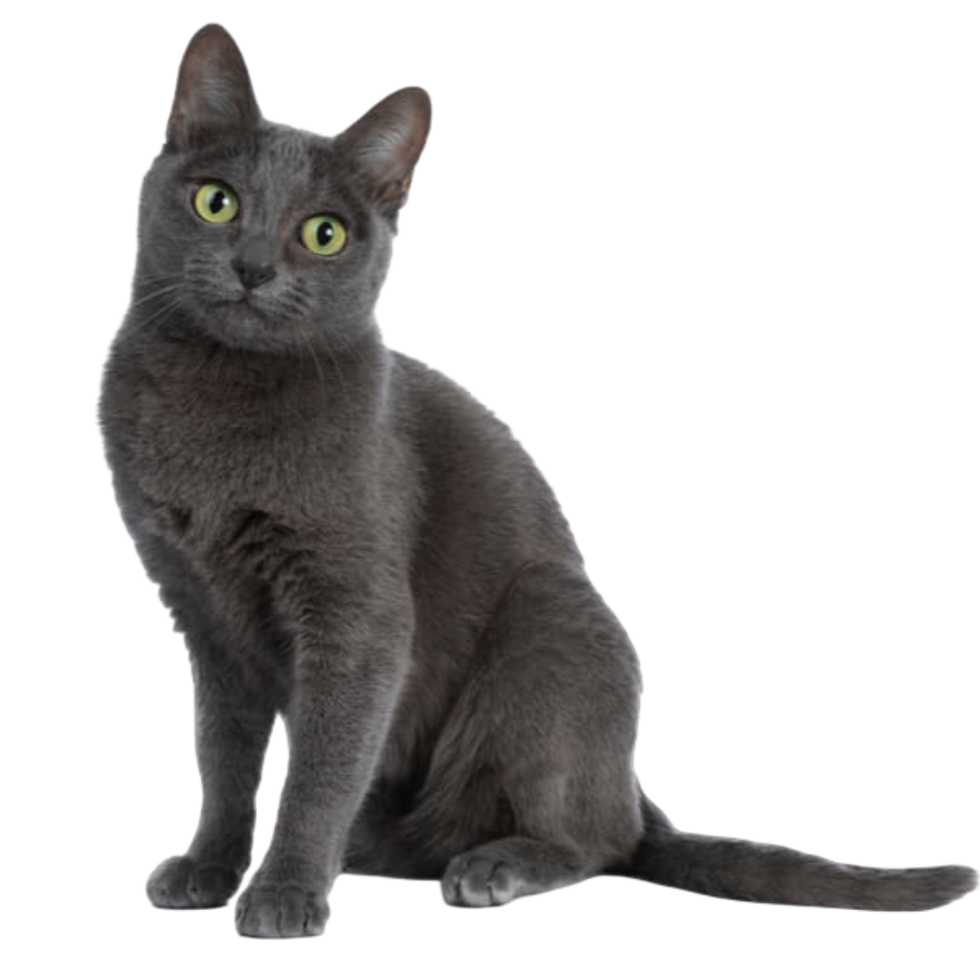
The Korat has a distinctive and elegant appearance that makes it easy to identify when compared to other cats. Its most notable feature is the heart-shaped head, with a broad forehead tapering smoothly to a rounded muzzle. The large, luminous green eyes are a hallmark of the breed, though younger cats may initially have amber eyes that gradually turn green with age. The coat is always a solid silver-blue, short, fine, and close-lying, giving the cat a soft, shimmering look. Unlike some similar breeds, such as the Russian Blue, true Korats are never bred in other colors or patterns, and their medium-sized but muscular body is surprisingly heavy for its size, adding to their unique identity.
Personality:
The Korats are affectionate, deeply bonded to their families, and often described as “velcro cats” because they like to stay close to their people. They are intelligent and curious, always eager to be involved in whatever is happening around the house. Despite their gentle and sweet nature, Korats can be quite vocal and persistent when they want attention, often communicating with soft but expressive voices. They are playful without being hyperactive, enjoying interactive games and puzzle toys, yet they also value quiet moments curled up in a lap. While generally friendly, Korats tend to form strong attachments to one or two people and may be reserved or cautious with strangers until they feel safe.
Health & Care:
The Korat has a short, fine coat that is close-lying and smooth to the touch, requiring very little grooming. The fur does not have an undercoat, so shedding is minimal, and the breed generally maintains a sleek, tidy look with just occasional brushing.
Hygiene
Full baths are rarely needed and only when the cat is visibly dirty, using a mild, cat-safe shampoo.
Nails should be trimmed every 2–3 weeks with a proper cat nail clipper; if unsure, a veterinarian or professional groomer can assist.
Teeth should be brushed 2–3 times per week using a cat toothbrush and pet-safe toothpaste—ask a vet to demonstrate proper technique if you’ve never done this before.
Ears should be checked weekly and cleaned gently with a cotton pad or a vet-recommended solution as needed.
Common Health IssuesThe Korat is generally a healthy and long-lived breed, but like all purebred cats, it can be prone to certain inherited conditions. One of the main concerns is Gangliosidosis, a rare genetic disorder that affects the nervous system; responsible breeders test for this to ensure kittens are not carriers. Some Korats may also experience issues with asthma or heart disease, particularly hypertrophic cardiomyopathy, though this is not as common as in other breeds. Regular veterinary checkups and responsible breeding practices play an important role in maintaining the health of the breed. |
History:
Origin
The Korat has a long and cherished history that traces back to Thailand, where it is considered a symbol of luck and prosperity. Known in its homeland as the “Si-Sawat cat,” the breed was traditionally gifted to newlyweds and esteemed figures as a blessing for good fortune, fertility, and wealth. References to the Korat can be found in ancient Thai manuscripts dating back to the 14th century, particularly in the Tamra Maew (Cat-Book Poems), where the breed was celebrated for its shimmering silver-blue coat and striking green eyes. While the Korat remained primarily in Thailand for centuries, it was first introduced to the Western world in the mid-20th century, arriving in the United States in the 1950s. Since then, it has retained its reputation as a rare and revered cat, still closely associated with its heritage as a living symbol of good luck.


Comments